
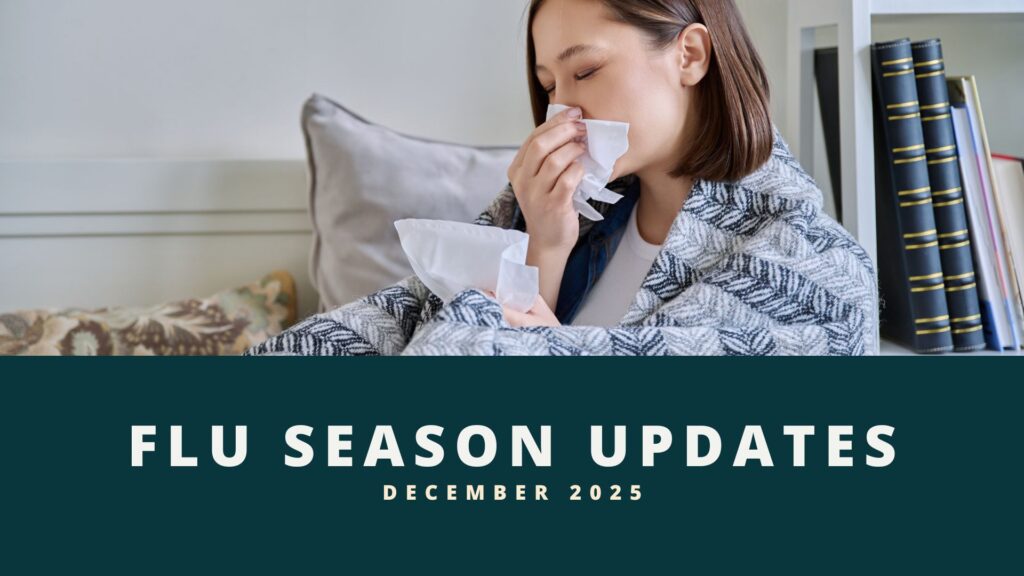
Winter is here, bringing cold temperatures, snowy days, and—unfortunately—the flu.
Each year the flu hits a little differently, with some strains far more vicious than others. So I was curious…how is this year looking for the flu?
To find out more, I connected with Andrea Green, RN, the Infection Prevention Specialist at Cook Hospital, to gain a little more insight into how the flu season is unrolling this year—as well as some practical guidance for staying healthy.
Here’s what she had to say:
Flu Season Updates: December 2025
Typically, the flu season tends to spike more in December/January, which we are noticing this year as well. There have been a few outbreaks throughout the state of Minnesota in schools (35) as well as some long-term care facilities (5). Most of the cases this year are Influenza A.
Note: The state of Minnesota shares up to date flu season stats on their website.
Tell us more about the flu. Isn’t it just a bad cold?
Colds are typically caused by a group of viruses called rhinoviruses. (Fun fact: there are over 200 types of rhinovirus.) The flu is caused by the influenza virus.
There are a lot of similar symptoms. However, we often see that influenza tends to have a sudden onset, whereas a cold is more gradual. Influenza is also accompanied by a high fever (100F and above) and chills in most cases.
What symptoms should prompt someone to stay home, call their provider, or seek care?
If you have a fever, you should definitely stay home.
For symptoms like coughing, etc., we recommend that you use your best judgment. Individuals are often contagious for 1-2 weeks, and a case of influenza that seems mild for one person could be extremely dangerous to another.
If your symptoms are severe, don’t hesitate to seek care! Although there’s no medication that can “cure” the influenza, medical professionals can support some of the side effects of the virus (high fevers, dehydration, etc.).
Let’s talk about those at-risk populations
At-risk populations (children, the immunocompromised, those who are pregnant, and those who are 65 and older) may want to seek medical care earlier than others.
What are the most effective steps parents of school children can take to keep their kids and families safe this year?
Hand washing! Wash your kids’ toys and items that go back and forth from school. Keep your children home if they have fevers or are showing symptoms.
If someone in the household gets the flu, what can families do to reduce the spread at home?
Again, handwashing is key. A few other tips:
- Remember to cover your cough
- Don’t share cups/ utensils
- Frequently clean high touch areas
- Try to isolate in a separate area, if possible
Can the flu shot give someone the flu?
Flu vaccines cannot cause flu illness. Flu vaccines given with a needle (i.e., flu shots) are made with either inactivated (killed) viruses, or with only a single protein from an influenza virus
The nasal spray vaccine contains live viruses that are attenuated (weakened) so that they will not cause illness. (per the CDC)
For those who may be “late” getting vaccinated, is there still a benefit to getting the flu shot later in the season?
It’s never too late to get one! Flu season is generally October through March (which is over half the year), so there is still lots of time!
What does infection prevention look like inside the hospital this time of year?
We monitor closely for staff/residents/patients who have any flu-like symptoms. We test more frequently and encourage COVID/flu vaccines for those who live and work here. We encourage those who don’t feel well—staff and visitors—to please stay home, unless you are here to seek medical care.
I also really like to encourage people to wear a mask even if they just have a sniffle. Sometimes symptoms don’t show up as strongly in some people as they do others.
Any final reminders or simple habits you wish everyone would adopt during flu season?
Back to the basics: wash your hands, cover your cough, and stay home if you don’t feel well!
And as always, you can visit your primary care provider, an urgent care facility, or our hospital ER (open 24/7) if you need medical support.